Narrative Intelligence
No. 1: Before Language Became Data
Narrative Intelligence No. 1 explores how AI and Large Language Models are reshaping human communication, story, agency, relational skills, culture, and what it means to remain human.
Mohsin Mohi Ud Din | September 2026
The Unseen and Uncertainty
A pillar of being human is how we see, feel, and interact with uncertainty — with the unseen.
Our fears.Our ignorance.Our scarcity.Our abundance.Our hopes.Our prayers.
Look at the things we have created as a species, across civilizations, that were previously unseen, nonexistent. Created by leaning into the unseen, the uncertain.
A song.A painting.A book.Science.A religion.Rituals.A cure.A diagnosis.A culture.
All these vessels of narrative intelligence.
Here we are, at a fragile point in human history dripping with uncertainty, increasing inequality, community fracture, and unreliable human systems. In comes a technology promising more conclusions — more solutions, less waiting, more convenience. What are we losing when our human processes for navigating the unseen are authored and automatically engineered by technologies and data?
In the absence of our ability as humans to dance with uncertainty, what happens to human agency, human narratives, and relationships? And if language and communication are drenched in inequality and disharmony, then are we not selling a future echo chamber of dehumanization and fracture among people, and between people and the planet?
Without perspective-taking, conclusion-making automated by machines can de-story our humankind and human agency.
Enter story. Enter narrative. Enter communication.
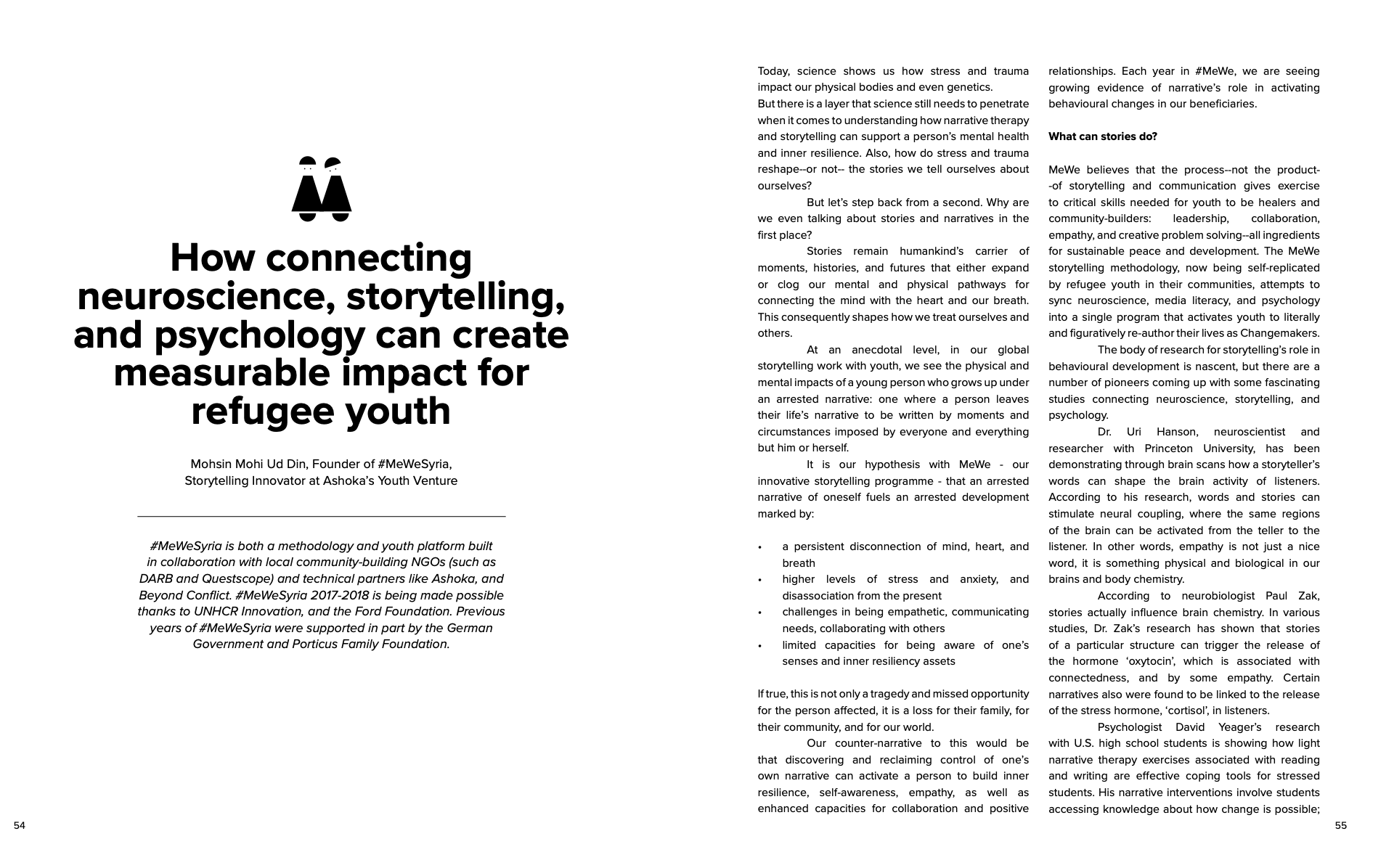
In the age of AI, Narrative Intelligence is the human capacity we must protect: our ability to use story, memory, language, ritual, and relationship to make meaning, build trust, repair harm, and remain human with one another. Before human narrative and communication became automated data, they were physical, spiritual, and embodied. What we feel makes us human and keeps our species alive, safe, and connected.
What Is Narrative Intelligence?
Welcome to Narrative Intelligence (N.I.) No. 1, the first in a series of essays rooted in my original writing, lived experience, and evolving ideas — developed in dialogue with AI tools used to support research, summarize sources, test questions, and synthesize the broader field.
First off, what is Narrative Intelligence? It is a fragmented term that carries different meanings depending on what sector, science, discipline, or angle you are coming from. So there are layers to this. But we, especially those of us from overlooked and underrepresented communities, also need to give ourselves permission to define Narrative Intelligence as a holistic, multidimensional term. We will get into it over a series of essays on this website.
In the meantime, here is how I am approaching Narrative Intelligence, building from previous research, philosophies, and scientific explorations on the topic:
I’m approaching Narrative Intelligence as a synthesis of narrative psychology, cognitive science, narrative therapy, narrative medicine, Indigenous Storywork, Indigenous research methodologies, African oral storytelling traditions, and AI-era concerns about language, agency, and human communication.
Narrative Intelligence is the human and communal capacity to shape meaning, memory, identity, behavior, and belonging through story.
Drawing on Western science, research, and psychology, Narrative Intelligence recognizes that human beings do not simply process information; we organize experience through narrative. Cognitive science and narrative psychology show that stories help us make sense of experience, form identity, integrate the past with the imagined future, regulate emotion, and act with agency (Bruner, 1990; McAdams & McLean, 2013). Human beings are not only data processors. We are meaning-makers. We live inside stories, inherit stories, resist stories, and revise stories in order to understand ourselves and the world.
But Western science is not the only lineage of knowledge. Long before modern psychology named narrative as meaning-making, Indigenous knowledge systems understood story as relationship, ceremony, land memory, ancestral knowledge, and communal responsibility. With this lens, Narrative Intelligence goes further. Indigenous Storywork teaches that stories must be held through respect, responsibility, reverence, reciprocity, holism, interrelatedness, and synergy (Archibald/Q’um Q’um Xiiem, 2008). Indigenous research methodologies teach that knowledge is relational, and that research, story, and listening require accountability to the relationships that make knowledge possible (Wilson, 2008; Kovach, 2009). Land-based Indigenous scholarship reminds us that story is not separate from place, body, ecology, and collective survival; story is part of how communities transmit intelligence, values, and the skills needed to rebuild humane futures (Simpson, 2014; Kimmerer, 2013).
In my attempt to synthesize Western science, psychology, Indigenous research, Eastern wisdom traditions, and African oral traditions, I increasingly fall on Narrative Intelligence as the ability to understand how stories live inside bodies, communities, cultures, technologies, and systems—and how they can wound or heal, divide or connect, erase or remember, control or liberate. It draws from narrative therapy’s insight that people can suffer under dominant stories and reclaim agency through re-authoring life narratives (White & Epston, 1990). It draws from narrative medicine’s insistence that healing requires the capacity to recognize, absorb, interpret, and be moved by others' stories (Charon, 2006). It also draws from African, Indigenous, and oral traditions that understand storytelling as a living system of memory, ethics, ritual, identity, and community repair (Osei-Tutu, 2022; Nwoye, 2022).
In the age of AI, Narrative Intelligence matters urgently. AI has been around for some time. But AI’s integration with Large Language Models helped make it accessible, interactive, conversational, and relational for all of us, not just computer scientists. Large Language Models are trained on massive amounts of text data, and they have become powerful systems for language understanding and generation. Machines mediate more of our human language communication, and they now shape how humans communicate with one another. Complement this research with the fact that human beings are speaking fewer words- almost 300 fewer words a day- and it is clear how we communicate as a species is changing, as so too is our human agency (Pfeifer & Mehl, 2026). Narrative Intelligence asks whether our technologies will deepen human agency, dignity, memory, and relationship — or reduce story to data, persuasion, prediction, and control.
As AI systems become more involved in communication, education, companionship, knowledge-sharing, and public discourse, we must ask not only whether machines can generate language, but what kind of humans we become when more of our language is mediated by machines.
Across my global community work in more than 20 countries over the last 15 years, I have come to see Narrative Intelligence as a living story of remembrance and repair. Remembering that before story became content, before language became data for the algorithm, before communication became automation, story was breath, body, rhythm, ritual, survival, and relationship.
As a father, as a minority person of color, as a community worker, as an artist, Narrative Intelligence feels existential to me because climate change, AI, political violence, public health, and social fragmentation are all shaped by the stories humans tell about who matters, what is sacred, what is disposable, and what futures are still possible.
The AI Turn
We are making AI more human-like while dehumanizing people in our lived systems of culture, politics, health, economics, and law. How can we reclaim human communication and relational skills to preserve and advance humankind while protecting our planet?
More and more humans are becoming reliant on AI systems whose most human-facing layer is often language: chatbots, search assistants, tutors, companions, recommendation systems, and automated decision systems.
If the trends show AI is now a mediator of human communication, knowledge-sharing, education, work, companionship, and meaning-making, it becomes vital to understand how human communication and LLM-driven systems can either strengthen or weaken human agency, relational skills, truth, dignity, and collective life.
The term we keep hearing is “a new era,” or that AI mediates more of our communication, knowledge, memory, and relational practice- human implications and human agency behind these seismic shifts. One of the dominoes falling right now with the AI era, for humans, is a communication and social revolution. Without communication, we have no community. And without community, we have no culture, no social cohesion, and no cooperation to protect, grow, relate, or step into a shared future.
What kind of humans are we becoming when more of our communication, knowledge, memory, and relational practice is mediated by AI?
The Human Risks
The relational side is emerging fast. Research on AI companions shows possible benefits, including perceived social support and reduced loneliness, but also raises concerns about dependency, design, and whether AI companionship may impair real-world social engagement. (DOI) Current research shows that adolescents are using AI chatbots and AI companions not only for schoolwork and information, but also for emotional support, advice, social practice, companionship, serious conversations, and mental-health-related guidance. Surveys from Pew Research Center, Common Sense Media, and JAMA Pediatrics show meaningful adoption: 12% of teens use chatbots for emotional support or advice, 33% use AI companions for social interaction and relationships, and 19.2% of adolescents and young adults use AI chatbots for mental-health advice. (Pew Research Center) Early clinical studies suggest possible short-term benefits for distress and depression, but safety studies show serious risks, especially when minors use general-purpose or companion chatbots without adult or clinical oversight. (JAMA Network) If youth use AI for emotional support but do not disclose that use to adults or clinicians, distress can become hidden inside a private human-machine relationship. That may delay real-world support, especially in high-risk situations. That matters, because a key variable supporting human physical and mental health is social connectedness, not isolation.
The risk is not simply that AI gives bad answers and sometimes demonstrates dangerous behavior. It is more complicated than that. The deeper risk is that AI may reshape the muscles of human relationships by reshaping human communication and narrative itself. If people increasingly outsource apology, comfort, advice, disagreement, reflection, and emotional disclosure to systems designed to be instant, agreeable, and endlessly available, we may become less practiced in the slow, difficult, reciprocal work of human agency and connection.
Research already shows that AI-mediated communication can change language and social perception, and scholars have begun warning that habits practiced with AI may leak back into human-directed communication and judgment. (DOI) Research also shows that AI-generated language is entering everyday communication at massive scale through smart replies, writing tools, translation, autocomplete, and other systems. (PubMed Central (PMC)) At the system level, researchers studying model collapse warn that generative AI can change the online text and image ecosystem, and that future models may be trained on environments already shaped by AI-generated material. (Nature)
Based on current research and my own inquiry, AI can strengthen human life when it helps people:
Access knowledge more easily
Translate across languages
Practice communication
Learn difficult concepts
Write, reflect, and organize ideas
Receive support when isolated
Reduce barriers for disabled, displaced, marginalized, or under-resourced communities
Strengthen human creativity and agency
But science and human experience also show us that the source material for AI — we human beings — battle some of the following:
Human neuropsychological realities and biases: fear, belonging, othering, trauma response
Human preference for time-saving and convenience over depth and nuance
Human systems’ addiction to power and resource extraction under capitalism
AI can diminish humankind when it causes people to:
Outsource thinking instead of developing judgment and perspective-taking, including cognitive empathy
Confuse fluent language with truth
Lose writing, listening, memory, or conflict-resolution skills
Replace human relationships with simulated intimacy
Become easier to manipulate through personalized persuasion
Flatten culture, story, spirituality, and lived experience into extractable data
Accept machine-generated narratives as reality
A key element of human agency and humanness is our ability to swim in the unseen and uncertainty, and from this drive the creation of culture — not echoes of culture filtered through a machine.
The Invitation
More and more, it is becoming clear to me that AI is not only a technology revolution. It is a communication revolution carrying implications for human health, human rights, culture, and the future of the planet. If Large Language Models are built from human language, and human beings increasingly use LLMs to mediate language, then the central question is whether AI will deepen or degrade our capacity to remain human with one another.
That question is no longer abstract. It is already shaping classrooms, workplaces, families, friendships, politics, and public life.
We must give ourselves permission to define Narrative Intelligence in the context of a communications revolution happening right before our eyes with AI. Our humanity, our rights, our spirituality, our health, and land depend on us exercising, not offloading, our human agency. Right now. All of us.
In the next installments of this Narrative Intelligence series, I will explore the history of human communication, reimagine what Narrative Intelligence means, and build a body of knowledge for how story shapes human health, culture, safety, and collective futures.
Stay tuned for NI No. 2.
Love over fear,
Mohsin Mohi Ud Din
What I’m Reading (so far…)
Bruner — Acts of Meaning
McAdams & McLean — “Narrative Identity”
Ricoeur — Time and Narrative, Vol. 1
White & Epston — Narrative Means to Therapeutic Ends
Charon — Narrative Medicine
Osei-Tutu — African Oral Traditional Storytelling Framework
Nwoye — African Psychology: The Emergence of a Tradition
Edwards — Ubuntu and mental health promotion
Opare — Sankofa as Praxis
KhoiSan healing dialogues article
Maat and human communication
Shiller — Narrative Economics
*Disclosure: This series of essays is rooted in my original writing, lived experience, and evolving ideas — developed in dialogue with AI tools used to support research, summarize sources, test questions, and synthesize the broader field.
UNited nations
x
Mohsin, 2017